
.png)
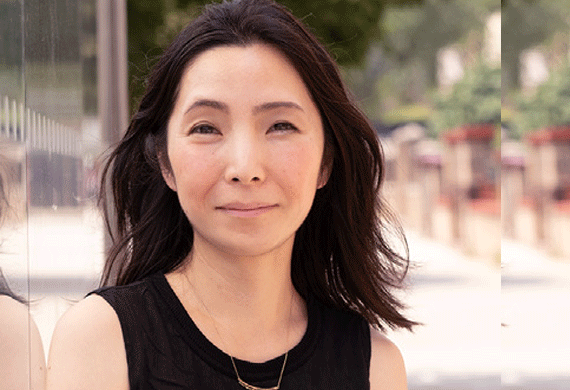
The contemporary architectural world is being disrupted by visionary architects who blend modern design with architectural history. One such accomplished architect is Yumiko Matsubara. Armed with a career spanning cultures and continents, she blends industry expertise with innovative technology to create impactful architectural designs.
From her early years working with Japan's esteemed Takenaka Corporation to her stint at globally respected firms such as Rafael Viñoly Architects and BIG (Bjarke Ingels Group), Yumiko established an ironclad foundation in large-scale urban development as well as complex, high-concept design.
With degrees from Harvard's Graduate School of Design and the University of Tokyo, she immersed herself in cross-cultural and academic experiences, including a life-altering stint studying under the legend, Rem Koolhaas at AMO/OMA in the Netherlands. These international influences informed her integrated design philosophy, one that unites context and beauty with stunning sensitivity.
Her decision to establish an individual practice, Yumiko Matsubara Architecture + Design, was triggered by collaborative prospects with alma mater peers and driven by a need for creative freedom. While establishing an independent practice in a competitive market like New York presented its own challenges, Yumiko's determination and global credentials became winning assets.
Yumiko’s flexible yet ambitious practice as a full-service architectural firm starts its client services from conception to all the way through construction and project completion, while guiding an expanding team. Whether creating a Japanese spa in Manhattan or a master plan development in Japan, she combines a scarce balance of technical acuity and visionary imagination.
Share your academical background and career journey in architecture.
I earned my bachelor’s and master’s degrees from the University of Tokyo in 2005 and 2007, and a Master of Architecture from Harvard GSD in 2018. I began my career at Takenaka Corporation, one of Japan’s largest architecture firms, where I spent nine years on design-build projects.
After Harvard, I joined Rafael Viñoly Architects in New York, contributing to major projects including a New Jersey courthouse, a national museum in Texas, a private gallery in NYC, and international work in Argentina. I then worked at BIG (Bjarke Ingels Group) for over three years, focusing on large-scale urban projects in Japan such as Toyota’s “Woven City” and a confidential development in Tokyo as well as local U.S. projects, like a police station in the Bronx and a museum in Texas.
What led you to study architecture at Harvard? How did the experience shape your perspective?
While working in Japan, I met Harvard interns whose impressive work inspired me to apply to the Harvard Graduate School of Design, which I joined in 2016. Moving to the U.S. for the first time, I was deeply influenced by Harvard’s inclusive and diverse environment, with top global professionals on the faculty.
A highlight was a study abroad program at AMO/OMA in the Netherlands, where I learned from Professor Rem Koolhaas, who is an innovative architect and influential academic known for his work on urban history and architecture. Touring Rotterdam with him and hearing his reflections on modern design and architectural history left a lasting impact on me.
What inspired you to establish Yumiko Matsubara Architecture + Design? What challenges have you encountered in the process?
In 2024, I launched Yumiko Matsubara Architecture + Design, which I’ve been running independently for nearly a year. When I was working at BIG, two of my Harvard classmates, both entrepreneurs, approached me. One, running a real estate company, asked me to design a dormitory for international students in Japan. The other, who runs a consulting firm in Japan, wanted help with a commercial project in New York. I found both projects interesting and began working on them independently.
Balancing these with a full-time job became tough, and also I was always more interested in working toward my ideas rather than someone else’s. So, I decided to start my own practice. Though challenging, it felt worthwhile.
Starting an architecture office alone is demanding, because managing the workload and building a team is no small task. I was fortunate to start with two clients, but without deep local ties, finding new ones in New York has been hard. I didn’t have family connections, unlike few others.
Team-building was also a challenge. I had supportive friends, but New York is expensive. I believe in fair pay and don’t support unpaid work, for myself or junior designers. Negotiating fair fees while handling a heavy workload remains one of the biggest hurdles.
What services does your firm offer? How does your experience benefit your clients?
I offer full-service architectural solutions, starting with concept development and programming to identify client needs. We then move to planning, which includes allocating functions within the layout, alongside site analysis, code compliance, and volume studies to maximize build potential. We handle both interior and exterior design, create visual renderings, and prepare detailed construction documents. I also manage the construction phase through site visits to ensure everything aligns with the design.
Negotiating fair fees while handling a heavy workload remains one of the biggest hurdles in entrepreneurship
Every project is unique, architecture can’t be mass-produced. Each site or renovation requires understanding its specific potential, and clients often aren’t sure what they need. My strength lies in the diverse experience which enables me to guide clients beyond their initial ideas, helping them discover untapped possibilities in their site and resources.
How is AI impacting the field of architecture? What is your perspective on incorporating AI within your work process?
AI is a relatively new development, but it’s already impacting our work significantly. Architecture has always evolved with technology, from hand-drafting to computer-based tools, to today’s 3D modeling and renderings. New tools emerge every few months, constantly reshaping our process.
My perspective is shaped by nearly a decade of practice in Japan before returning to graduate school, giving me a solid mix of traditional and modern techniques. I now work with 2D drawings and 3D models in parallel, integrating design with technical and legal requirements efficiently.
I’m optimistic about AI and its integration into drafting and modeling tools. It saves time on repetitive tasks, like revisions, allowing us to focus on design quality. AI doesn’t replace architects but supports us by handling time-consuming work, so we can prioritize creativity, functionality, and compliance.
Yumiko Matsubara, Founder, Yumiko Matsubara Architecture + Design
Yumiko Matsubara is a professional architect and principal of Yumiko Matsubara Architecture + Design. Holding academic qualifications from the University of Tokyo and Harvard Graduate School of Design, she is transnationally qualified. She also has experiences, working for global firms such as Takenaka Corporation, Rafael Viñoly Architects, and BIG (Bjarke Ingels Group).
ON THE DECK

🍪 Do you like Cookies?
We use cookies to ensure you get the best experience on our website. Read more...
Copyright © All rights reserved. Global Woman Leader Contact Us About