
.png)
“As a CEO, I am finding that I have to become a learning CEO. I have to go to school all the time because I am learning new skills that I need to run this company… I have to constantly renew my skills,” said Indra Nooyi, Former CEO of PepsiCo.
Women entrepreneurs across the world are navigating 2026, faced with opportunities and challenges never seen before. As technology redefines entrepreneurship, the need for founders to develop new-age skills has never been more urgent. The World Economic Forum's Future of Jobs Report 2025 revealed that 39% of workers' current skills will be altered or made obsolete by 2030.
A great business idea alone is no longer enough to succeed in 2026. Women entrepreneurs need to be digitally fluent and financially literate as well as capable and adaptable leaders. In the future, successful start-up founders will be those who keep developing their skill sets to help them deal with a rapidly evolving business environment.
The Big Shift: Why Skills Matter More Than Ever in 2026
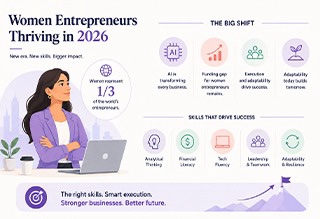 Entrepreneurship was passion, determination, and risk-taking for a long time. These characteristics are still relevant; however, today’s business world requires much more.
Artificial intelligence will soon weave itself deeply into everyday business scenarios. Brands that think and operate in the digital space are getting global customers on the first day. Creator-led businesses are disrupting traditional companies, while consumers crave more and more personalized and smooth experiences.
Moreover, women entrepreneurs are still not on par when it comes to funding. As per PitchBook's Female Founders Dashboard 2025 report, female-only founding teams received hardly 1-2 percent of VC deals in the US. As startup capital is tougher to raise for women founders, business efficiency and optimal use of resources become critical.
Clearly, entrepreneurial success is no longer just about an idea; it centres on execution. Thus, women founders must prioritise understanding technology, finance, team building, marketing, and market adaptability. Entrepreneurs who can successfully combine vision with practical skills will be the ones leading successful businesses in 2026.
New-age Skills that Women Founders Must Develop in 2026
Several global studies have highlighted the abilities that will determine the success of entrepreneurship in the near future.
The World Economic Forum's report on the Future of Jobs 2025 points out analytical thinking, resilience, leadership, understanding technology, and creative thinking as some of the skills with the fastest growth in the global workforce.
The findings suggest that the women entrepreneurs who will thrive in 2026 must be equipped with a well-rounded set of skills in business, technology, leadership, and development.
Let’s take a look at some of the key new-age skill sets that can enable women founders to turn business ideas into market success.
Pillar 1: Digital & AI Intelligence
The use of technology is increasingly turning into a competitive factor. The 2026 research in Discover Artificial Intelligence reveals that women-led businesses that adopt AI in a targeted manner achieve significantly higher levels of business agility and operational performance.
AI Adoption: Artificial intelligence has ceased to be an exclusive tool for large corporations. Women entrepreneurs are embracing AI for content creation, customer support, research, scheduling, and productivity.
What really matters is not mastering the technicalities of building AI systems but having a clear understanding of how AI can be leveraged to save time and enhance work efficiency. Business owners who make use of AI in a planned way can significantly cut down on their operational chores and dedicate more time to the expansion of their businesses.
Data-Driven Decision Making: The World Economic Forum considers analytical thinking as one of the most vital future skills. A huge amount of data is at the disposal of entrepreneurs, which includes data from websites, social media platforms, sales channels, and customer interactions.
Knowing how to make sense of this data enables founders to make wiser choices about products, marketing campaigns, and customer engagement.
Digital Marketing: DataReportal states that each day, billions of people are engaging with brands and businesses through the internet. Digital marketing has various specialties such as social media marketing, SEO, email marketing, content creation, etc.
Despite limited access to capital, female entrepreneurs can use digital channels to level the playing field with big brands.
Pillar 2: Financial & Business Intelligence
 Financial awareness is also an essential element. The Social Sciences & Humanities Open noted that financial knowledge leads to better decision-making and resource allocation among women-led small and medium-sized enterprises and greatly enhances their performance.
Financial Literacy: As seen in research from Social Sciences & Humanities Open, there is a clear correlation between financial literacy and the success of female-run small and medium-sized enterprises. Budgeting, profit, expenditure, and finance management allow an entrepreneur to make good business decisions.
Cash Flow Management: A majority of businesses fail due to cash flow problems, as opposed to having no clients. Female entrepreneurs who know how to forecast cash flows are able to budget better and plan for future investment.
Fundraising Readiness: Women-owned startups continue to struggle when it comes to raising money from venture capitalists, according to PitchBook. Therefore, entrepreneurs need to know how to craft their pitches, projections, and plans for investors. Being ready for fundraising will help increase the chances of raising money.
Pillar 3: Leadership & Human Skills
Team Building: Leadership is an essential skill for the future, according to the World Economic Forum. For growing organizations, leaders have to go past task management and start leading people. Building good teams involves effective communication, making hires, and performance management.
Emotional Intelligence: The findings have proven that emotional intelligence helps in good leadership. To women entrepreneurs, emotional intelligence will enhance their teamwork, resolve conflicts effectively, and develop positive work environments.
Decision-Making: Uncertainty is a constant factor in entrepreneurship. The choice to either enter a new market or introduce a new product into an existing market will almost certainly have to be based on incomplete data. Good decision-making abilities enable entrepreneurs to assess their risks and take steps confidently.
Pillar 4: Strategic Growth Skills
Networking and Partnerships: According to the International Council for Small Business (ICSB), mentoring and networking are key factors that help entrepreneurship grow. Networking is an avenue through which women entrepreneurs can connect with investors, customers, collaborators, and industry experts.
Personal Branding: The findings by LinkedIn's B2B Institute reveal that thought leadership impacts business decisions. Personal branding can help female founders enhance their credibility and visibility and open up more opportunities.
Customer-Centric Storytelling: Modern-day consumers are becoming more aligned with stories of authenticity. Entrepreneurial women who manage to communicate their purpose, values, and social impact can establish better connections with their clients.
Pillar 5: Future-Ready Mindset Skills
Adaptability: According to the World Economic Forum, resilience, flexibility, and agility are some of the most rapidly developing skills worldwide. Entrepreneurship involves individuals being adaptable to shifting market conditions.
Continuous Learning: As technology and the world of business develop rapidly, learning cannot end once one is out of school. The successful entrepreneurs keep themselves up-to-date by going through various courses, mentorships, and research.
Creative Problem-Solving: Entrepreneurship is all about problem-solving. Thinking creatively helps female entrepreneurs to find an opportunity and come up with innovative solutions.
Case Studies on How Women Founders’ Skill Sets Helped Them Succeed
 Many female entrepreneurs are already showing how the skills can be applied in practice.
Whitney Wolfe Herd, Founder and Executive Chair of Bumble in the USA, is an example of the significance of strategic growth, branding, and adaptation. Whitney built Bumble to become a market leader in the saturated dating app market by focusing on adaptation to new consumer needs. from replacing ‘swiping right’ to introducing ‘opening move’, Bumble has constantly understood consumer requirements and innovated accordingly.
The journey of Melanie Perkins, co-founder and CEO of online graphic design tool Canva, is also interesting. Although Melanie faced several rejections from investors during Canva’s early stages, she persisted by improving on her product and business idea until she ended up creating one of the most popular design platforms. And today, Canva is one of the most used online graphic design tools globally. Melanie’s journey with Canva demonstrates how critical it is for founders to continuously learn, showcase resilience, and be customer-focused.
The importance of creative problem-solving and technology adoption is showcased through the journey of Nigerian-American founder, Temie Giwa-Tubosun. She leveraged technology to establish LifeBank in 2016. Using digital platforms to solve challenges related to access to blood and other medical products, she turned a major healthcare challenge into a sustainable business model.
This is clear proof that future-ready skills are not just theoretical notions, but have a practical impact on business results.
Challenges Women Founders Face in Building New-age Skills
Though acquiring skills is necessary, access to skill development is not a level playing field for women founders across the globe.
Women entrepreneurs encounter significant obstacles, including a lack of access to finance, mentors, and networking. As indicated by PitchBook statistics, startups founded by all-female teams account for merely 2-3% of venture capital funding worldwide, demonstrating that access to finance remains one of the key structural barriers. The application of technology could also prove difficult for those running businesses in smaller cities or places where resources are scarce.
Time is yet another key challenge. Most women entrepreneurs juggle entrepreneurship duties along with other home and childcare duties, hence, less time to develop skills formally. According to the research by UN Women, women do two and a half to ten times more unpaid care work compared to men in different regions. This reduces their time to develop skills and businesses.
It will take investment and collaboration by investors, government, institutions of learning, and the entrepreneurial ecosystem to tackle these issues.
The Future Skill Equation
Entrepreneurship in the future is not going to be characterized by a specific innovation or trend but by founders who successfully integrate several abilities to build a competitive advantage.
In a world characterized by constant changes, digital literacy, financial knowledge, leadership, strategic growth, and adaptability are more and more critical.
These competencies for women entrepreneurs are not negotiable anymore, but the keys to success in winning customers, attracting investment, assembling teams, and scaling up.
The issue today is not whether women entrepreneurs will be capable of adapting to the future but how quickly they will be able to reshape it.
Latest Issues
🍪 Do you like Cookies?
We use cookies to ensure you get the best experience on our website. Read more...
Copyright © All rights reserved. Global Woman Leader Contact Us About