
.png)
Explore the latest women in AI statistics, gender gap trends, workforce challenges, leadership representation, and future opportunities in the AI era.
Artificial Intelligence (AI) today is not a mere promise of the future; it is altering the way the world works, hires, creates, and competes. Evolving at lightning speed, AI and automation are redefining efficiency in industries across the globe.
However, on the flip side of this innovation lies a stark reality – women’s conspicuous absence across the global AI ecosystem.
Women continue to be a minority in the global AI workforce, especially in technical and leadership roles. Women in AI Statistics 2025-2026, found that women constitute a small portion of the global AI workforce, and their numbers in the leadership positions are even lower.
Additionally, the World Economic Forum's report on AI gender gaps points at AI’s potential to further workplace inequalities. Roles primarily held by women are most likely to be automated says the report.
AI has emerged as a double-edged sword for women: not only are women absent from the rooms where AI is developed but they are also more vulnerable to the disruptions caused by it.
This begs a critical question - will AI be used as a means of empowerment, or will it extend gender disparities further?
A Look at Women in the AI Workforce: What Statistics Say
Women’s position in the AI workforce continues to be shaped by persistent inequality that extend beyond mere statistical representation. Women represent a small minority of AI specialists worldwide; studies show that they make up approximately 22% to 30% of the AI workforce. Moreover, the number of women leaders in senior positions is less than 15% according to Women in AI Statistics 2025-2026.
Nature of Roles Held by Women in AI: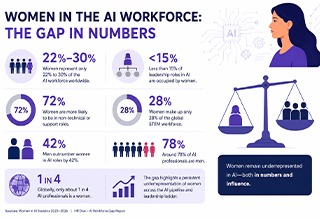
Gender disparity in AI is further highlighted in the nature of positions held by women. Women, while being part of the wider tech ecosystem, tend to hold roles that are either non-technical or support-oriented, rather than core AI development roles, such as machine learning engineer or data scientist. This disproportionate representation restricts women’s contribution to how AI systems are designed and rolled out.
Gender Hiring Gap in AI:
Hiring trends further strengthen this imbalance. As per research cited by HR Dive report on AI workforce gap, men outnumber women in AI roles by 42%, indicating pipeline challenges and persistent hiring biases.
A Larger Systemic Issue:
Comprehending why women are underrepresented in AI goes beyond workplace structures. Challenges such as underrepresentation of women in STEM play a crucial role. Women form only 28% of the overall STEM workforce globally, according to statistics from Women in AI Statistics 2025-2026. Women receive fewer mentoring opportunities and face gender bias in recruitment and promotion.
These factors combined lead to a stark AI gender gap,
AI Gender Gap Explained- Biased AI Systems
The AI gender gap goes beyond unequal representation; it also takes into account AI’s impact on different communities and demographics.
The World Economic Forum's report on AI gender gaps warns that unless organic action is taken, AI will exacerbate existing gender inequalities within societies.
Global analysis indicates that although the issue is universal, the solutions need to address local realities. With appropriate investments in information technology and education, developing countries can encourage broader inclusion in the AI ecosystem.
AI is not neutral by design; it is shaped by the data it is fed and the choices of people who create it. If women are missing in the data and the developing teams then the resultant systems may unintentionally carry gender bias in hiring, evaluation, and even workplace relations.
Various researches have discovered that AI systems and chatbots, specifically ChatGPT, can further gender biases due to inherent flaws in training data, algorithms, and user feedback loops.
Consequently, the AI gender gap goes beyond employment challenges.
AI’s Impact on Women’s Employment
.png)
AI’s impact on women’s employment is one of the most critical challenges caused by the AI gender gap.
AI is designed to replace repetitive, routine, and administrative tasks. Tasks such as clerical work, customer support, data entry, administrative services etc, have traditionally employed a large number of women. As AI’s capabilities grow, the vulnerability of these roles also increases.
According to an ILO report, women are twice as likely to be lose their jobs to generative AI as compared to male-dominated ones, since their roles are more automation-friendly.
Additionally, AI’s impact is not only felt in the labour market, but also in the workforce’s capabilities. For instance, individuals in high-skill, technical jobs that are likely to gain efficiency through AI are largely male. This could lead to men attaining further career growth while women face greater chance of roles becoming redundant.
This difference indicates a larger challenge: AI doesn't only alter jobs; it also differentiates between who benefits from the advantages of AI.
Why Women Remain Underrepresented in AI
In order to find solutions to improve women’s representation in the AI ecosystem, it is critical to first understand what impairs their entry into the world of AI. Is it education? Or workplace dynamics? Or technology design?
The AI gender gap is caused by an amalgamation of these factors.
 The Broken STEM Pipeline:
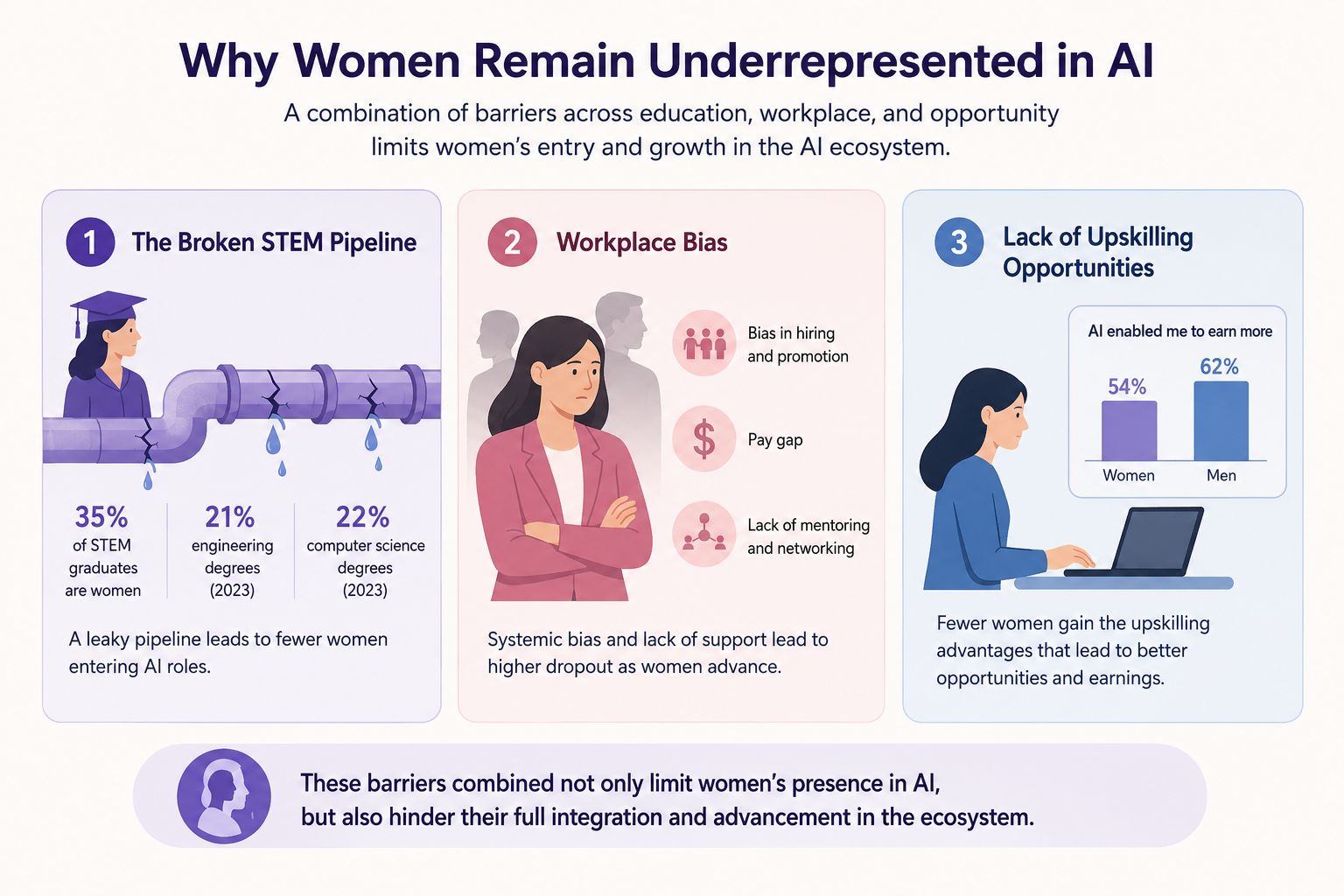
The problem begins with the leaky STEM pipeline. Women constitute only 35% of all STEM graduates worldwide, without any significant change in this statistic over the last ten years, according to UNESCO. Women comprised only 21% and 22% of engineering and computer science degrees conferred in 2023, respectively. Moreover, in the UK, women and non-binary students constituted only 23% of computer science enrolment in 2022/23, an increase from 19% in 2018. This data suggests that achieving gender parity in STEM education could take more than 30 years.
Lesser graduates lead to subsequent disproportionate representation of women among candidates applying for AI-based roles, leading to their absence in the workforce as well.
Workplace Bias:
Persistent workplace bias amplifies the gender AI gap. Women often face systemic discrimination in the hiring and promotion pipeline. The pay-gap is another strong deterrent. A culmination of these challenges result in more women dropping out of the AI as they move up the ladder. Unfortunately, such systemic biases are supported by the absence of mentoring and networking opportunities.
Lack of Upskilling Opportunities:
Access to upskilling opportunities also represents another crucial barrier. This has been illustrated by the Udacity AI at Work Report 2025, where the data show a disparity in the advantages gained in terms of work opportunities and earnings between men and women, regardless of whether they hold technical or non-technical jobs. In particular, the survey found that fewer women than men indicated that AI had enabled them to earn more money (54% compared to 62%).
Combined, these barriers not only highlight the lack of women's presence but also pose further challenges to their complete integration into the AI ecosystem.
How the AI Gender Gap Affects Career Growth for Women
AI is being widely adopted owing to the business advantages it brings along. However, data suggests that an increasing number of women could be losing on the benefits of AI.
According to the Udacity AI at Work Report 2025, women are less inclined to say that AI tools helped them become more efficient, creative, and productive as compared to their male counterparts. It also indicates that women in the workforce are not gaining the same level of benefits from AI implementation as men.
Women receive fewer benefits because they have lesser access to the right AI tools and training. This disparity is evident in income growth as well. Data also suggests that women engage less with new generative AI solutions as compared to the widely adopted ones.
The HR Dive report on the disparity in the AI workforce and what it means for the opportunities of those without AI skills highlight the connection between the gap in AI roles and the resulting unequal opportunities for growth.
Therefore, the AI gender gap it is not only about access to jobs but also about access to outcomes.
Future of Work for Women in the AI Era
The future of work for women in AI era cannot be confined to redundant roles alone; it will also be about transformation.
AI is causing a shift from routine skills to critical skills such as creative, analytical, and adaptive thinking. This shift will create new job roles, many of which may include collaborations between humans and AI technologies. Based on the Udacity AI at Work Report 2025, women are 10% less likely to see an increase in efficiency and 9% less likely to experience an increase in creativity as a result of using AI compared to men.
It is important for women to recognize the skills they will require to excel in new-age roles. The focus must be on technical skills to human-centric skills, including data literacy, AI basics, as well as effective communication and problem-solving.
Women who combine AI skills with domain expertise will be better positioned for emerging roles in analytics, governance, and AI-assisted decision-making.But their growth and relevance will largely depend on their ability to adapt to these changes.
How Women Can Futureproof Themselves
 Adjusting to an AI future involves a proactive approach.
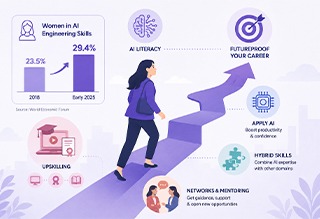
AI literacy is the first step for women to adapt to the AI era. Working women must begin with understanding how AI functions and its practical applications in the workplace.
Women are gradually yet steadily moving towards AI literacy and AI engineering skills. In 2018, 23.5% of the listers of AI engineering skills on LinkedIn were women, whereas in early 2025, the number had gone up to 29.4%, as per WEF.
Upskilling should also be considered important. Participating in training programs, online learning, and certification could prove to be instrumental in bridging the knowledge gap. The Udacity AI at Work Report 2025 highlights the significance of ongoing learning.
The use of AI technology in day-to-day work processes can improve productivity as well as confidence. Apart from technical competencies, acquiring hybrid competencies that involve gaining expertise in AI and other domains will be imperative.
Networks and mentoring are also critical for futureproofing in helping guide career paths and open new avenues.
Futureproofing will involve require women to be adaptable, informed, and active, rather than becoming an expert in AI technology at once.
Women in AI Leadership
The significance of women in AI leadership roles cannot be overlooked. Only when women will be actively part of rooms where AI systems are designed and the future of AI is decided, can the ecosystem become truly gender neutral. The absence of diverse voices in AI development could have far reaching consequences, with the entire system having blind spots.
The future of AI will depend on the decisions being made right now; those that hire inclusively, those that provide education, and those that learn throughout their lives.
The real question isn’t whether women will join the AI revolution or not; instead, it is about how deeply women will be involved in the creation of that revolution.
Because the future of AI won’t just be about code, it’ll be about the people behind it.
Latest Issues
🍪 Do you like Cookies?
We use cookies to ensure you get the best experience on our website. Read more...
Copyright © All rights reserved. Global Woman Leader Contact Us About