

.png)
The biotechnology industry is increasingly becoming a critical force in addressing challenges across agriculture, healthcare, food security and sustainability. Within agricultural biotechnology, the need for improved of crop protection, biological solutions, resilient crops and sustainable production practices is creating new opportunities for scientific innovation. At the same time, women leaders are playing a growing role in translating scientific expertise into commercially relevant solutions, building research-driven organisations and shaping the future of the sector.
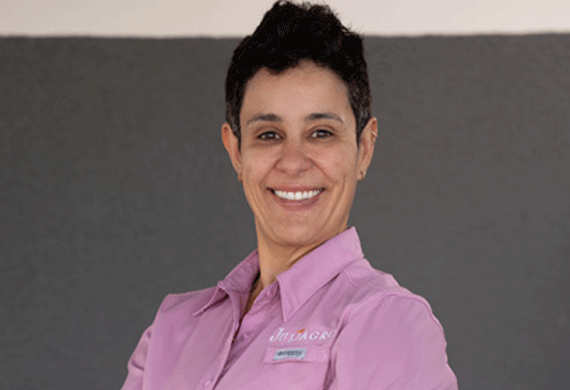
Among these emerging voices is Fernanda Juliatti, CEO of JuliAgro Research Institute, whose career reflects the intersection of agricultural science, research and entrepreneurship. Her connection with agriculture began early, influenced by her father, an agronomist and plant pathologist, and farmers antecessors even on mothers and fathers side, closely associated with the sector. This foundation led her to pursue agronomy at the University of Uberlândia, followed by a master's degree in plant pathology and a PhD in genetic studies.
Juliatti built her professional experience with companies including Syngenta and Ihara, working across biotechnology, genetics, crop protection, research and crop development. Her association with Syngenta's global team and experience across different regions of Brazil gave her a broad understanding of the country's diverse agricultural landscape.
Around a decade ago, she took an entrepreneurial step by establishing her own contract research organisation (CRO) in Brazil. What began as a small operation with a group of interns gradually developed into a larger research organization, with several of those early team members progressing into leadership roles. Four years later, JuliAgro expanded through the establishment of another CRO in a different region.
Today, JuliAgro works with more than 80 companies across seeds, crop protection, biologicals and other agricultural technologies. Its team comprises more than 26 agronomists, including postgraduate and master's-level professionals, and conducts around 800 projects annually across more than 40 crops. With operations spanning major agricultural regions and crops including soybean, corn, cotton, coffee, sugarcane, fruits and vegetables, Juliatti is contributing to the validation and advancement of technologies designed to improve productivity, quality and sustainability in Brazilian agriculture.
How has your scientific and research experience influenced your leadership approach as CEO of JuliAgro?
Knowledge and continuous learning are at the core of my leadership approach. Agriculture is highly dependent on nature, with changing factors such as rainfall, temperature and environmental conditions, so adaptability is essential. My experience as a researcher, agronomist and grower allows me to evaluate technologies from multiple perspectives. My brother and I are also researchers and growers, which gives us direct exposure to field challenges. I bring these practical experiences into our strategic discussions, combining scientific understanding with real agricultural conditions. This helps me make more informed, accurate and adaptable decisions for JuliAgro.
What key milestones or strategic decisions have played the greatest role in shaping JuliAgro?
Continuous investment in technology has been one of the most important factors in JuliAgro’s development. Every season, we evaluate where we can improve and invest in areas such as irrigation systems, sowing and harvesting equipment, drones and other advanced technologies. However, technology is only valuable when people know how to use it effectively, so we also invest heavily in training our team. Our growing project volume and expanding demand have reinforced this approach. By combining technological advancement, skilled people and an understanding of practical agricultural requirements, we have strengthened our ability to deliver high-quality research and experimentation services.
How does JuliAgro’s integrated laboratory, greenhouse and field approach help generate reliable insights?
Integrating laboratory, greenhouse and field experimentation allows us to understand technologies more deeply and generate reliable data. We can examine their performance at different stages and identify even small differences in their effects. For example, a fungicide may control disease while also influencing plant physiology. Field evaluation helps us understand these broader effects. This approach is particularly important in Brazil because environmental conditions vary significantly across its large tropical geography. By testing technologies under different conditions, we can better understand their potential, identify where they perform best and generate insights that support their development and application across different agricultural regions.
"Continuous Learning And Openness To Different Perspectives Have Shaped The Way I Approach Challenges"
What professional challenge has most influenced your approach to problem-solving and leadership?
Working in agriculture has taught me that successful problem-solving depends not only on understanding nature but also on understanding people. I believe in learning from individuals with different levels of experience and listening to their perspectives. Even advanced agricultural technologies ultimately depend on people to operate and manage them effectively. Empathy, therefore, is an important part of my leadership approach. I also believe learning should extend beyond agriculture. Understanding human needs, consumer behavior and broader scientific developments helps us anticipate changes in food demand and sustainability. Continuous learning and openness to different perspectives have shaped the way I approach challenges.
How is JuliAgro contributing to the development and validation of technologies addressing complex crop-protection challenges?
We are increasingly involved in evaluating biologicals, peptides and other emerging technologies that can help crops manage biotic and abiotic stresses. Our multidisciplinary team brings together expertise in physiology, pathology, nematology and entomology, allowing us to examine challenges from different perspectives. If I identify a potential effect outside my area of expertise, I involve the relevant specialist so we can investigate it collectively. We combine scientific literature, research data, practical agricultural experience and advanced equipment to understand complex technologies. This collaborative approach helps us develop stronger insights into solutions that can improve crop resilience, productivity and sustainability.
Fernanda Juliatti, CEO & Technical Director, Juliagro
Fernanda Juliatti is an agronomist, plant pathology specialist, researcher, and CEO of JuliAgro. With a master’s degree in Plant Pathology and a PhD in Genetic Studies, she brings extensive experience across biotechnology, crop protection, genetics, and agricultural research. She leads JuliAgro in advancing innovative technologies for productive and sustainable Brazilian agriculture for the last 26 years.
ON THE DECK

🍪 Do you like Cookies?
We use cookies to ensure you get the best experience on our website. Read more...
Copyright © All rights reserved. Global Woman Leader Contact Us About