
.png)
- Engineering and technical fields have traditionally been considered male-dominated fields
- Women have historically been dissuaded from entering these fields in many countries of the world
- Data from all over the world shows a change in the way these fields are viewed
Engineering and technical studies have long been considered a male-dominated field, with women not being encouraged to pursue careers in these areas in some countries.
However, this notion is changing gradually, as evidenced by data from around the world and opinions from experts that are being made available to Digital Journal.
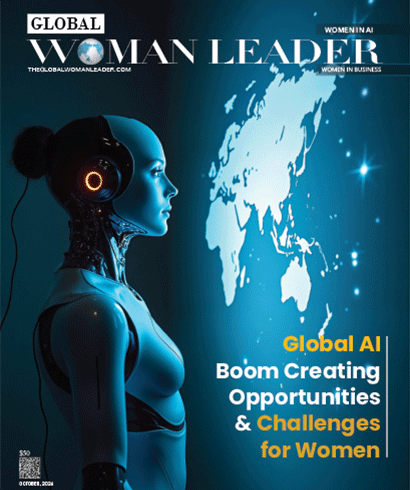
Despite the fears of how artificial intelligence might impact employment opportunities for people of different genders, women from many countries are contributing to the AI industry, particularly in the areas of STEM (Science, Technology, Engineering, and Math).
India has consistently ranked high in the number of women studying STEM subjects, and Middle Eastern countries are also showing significant numbers of women contributing to the AI industry.
In the USA, women comprise 35 percent of the total workforce in STEM studies. In comparison, the numbers are higher at 56 percent in Middle Eastern countries and 41 percent in India.
According to the National Centre for Biotechnology Information (NCBI), STEM graduates in India are female at over 40 percent. Female participation in STEM programmes in the UAE is also over 50 percent. In Malaysia and Tunisia, women are approaching gender parity in STEM education.
In the UAE, women are estimated to be approximately 56 percent of STEM graduates from public universities; in the broader Middle East, women's participation in STEM is typically estimated to be between 40 percent and 50 percent.
In other established education centers, including the United States, United Kingdom and Germany, there have been slower moves toward equality, but progress continues to be made.
Women comprise approximately 30-35 percent of STEM students in these countries, and Germany reached approximately 36 percent female participation for the first time recently.
Certain areas of STEM have progressed faster than others; fields such as artificial intelligence (AI) and engineering have seen greater numbers of women enter these fields over the last decade.
Women now comprise approximately 22 percent of the global AI workforce compared to about 15 percent 10 years ago according to the World Economic Forum. While still not equitable, there are indications that progress are being made.
Latest Issues
Most Viewed
🍪 Do you like Cookies?
We use cookies to ensure you get the best experience on our website. Read more...
Copyright © All rights reserved. Global Woman Leader Contact Us About