
.png)
Women are joining the workforce in almost equal numbers as men; however, they become increasingly underrepresented as they progress towards leadership positions. In the changing scenario created by the emergence of artificial intelligence and entrepreneurship, new research from LinkedIn and the World Economic Forum shows how women are being left behind due to factors like career gaps and skills shortages.
Artificial intelligence, entrepreneurship and technological advances are reshaping the workforce and creating new pathways to economic growth. Yet women remain underrepresented in many of the roles and leadership positions that are likely to shape the future economy.
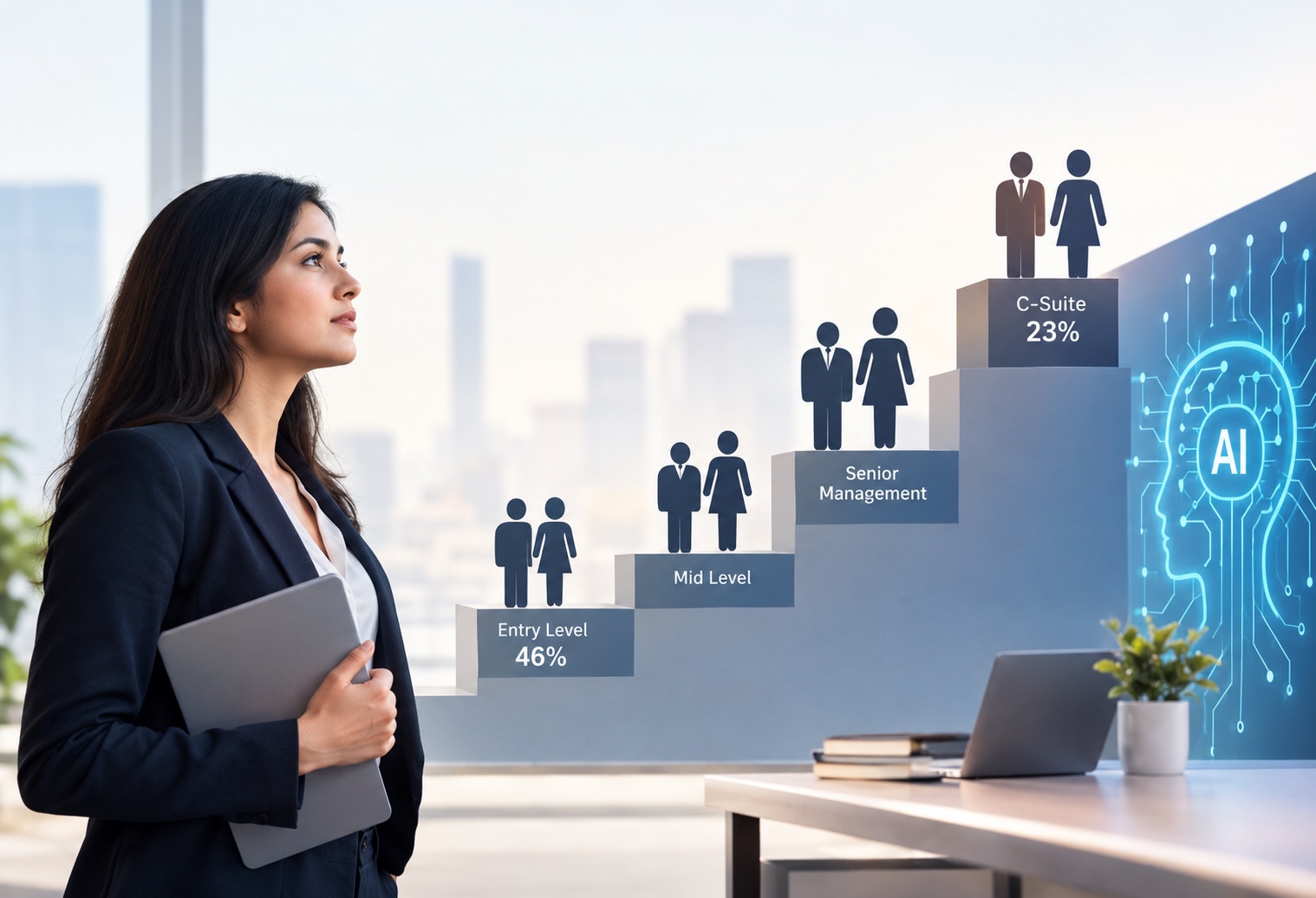
According to the latest information released on LinkedIn's Economic Graph in the World Economic Forum's Global Gender Gap Report 2026, while women make up 46% of entry-level employees, they only make up 23% of C-suite managers. Even though the share of women in top-management positions increased from 26.7% in 2015 to 29.6% in 2023, it has remained steady since then, and at the current rate of progress, it might take about 90 years to achieve gender equity in business leadership.
The issue is further magnified by the fact that there is a shift within the world’s economy towards jobs and entrepreneurship driven by AI. Apart from being underrepresented in terms of leadership roles, women are also underrepresented as AI recruits as well as AI-skilled entrepreneurs. This means that there is an increasing gap between women’s representation in the labour market and future economic opportunities.
Together, these trends point to a broader challenge: women are entering the workforce in significant numbers, but they are not advancing into leadership and emerging areas of opportunity at the same rate as men.
The question, therefore, is not simply how to bring more women into the workforce. It is how organizations can ensure women have access to the skills, career opportunities, sponsorship, leadership roles and entrepreneurial pathways needed to shape the economy of tomorrow.
Also Read: Women in AI: Understanding Gender Gap, Workforce Trends & Future Opportunities
 Women Enter the Workforce, But Disappear on the Way to the Top
A lack of women in the workforce is not the problem; women occupy almost 50% of the entry level jobs across all organizations. Almost 46% of women join the workforce of the organization in the initial stages of their career. However, women make up for only 23% in the C-suite levels of management hierarchy.
This decreasing trend reflects that there is a problem in retaining women in the corporate sector. Organizations might have been able to recruit women for jobs, but they do not succeed in promoting them at par with men.
In senior management positions, the proportion of women is quite low; women form 19%, 27% and 24% of CEOs, CFOs and COOs respectively. However, in functions involving people and communication, women occupy significant proportions, constituting 65%, 64% and 45% of chief people officers, chief human resource officers and chief marketing officers respectively.
This distribution is significant because it is not only a matter of getting to the C-suite. The kind of leadership role also indicates the level of influence on operational decisions, funding decisions, corporate strategy, and the overall direction of the organization.
The numbers indicate that women have a narrow road leading to some of the most operationally influential positions in the business world.
Career Breaks Can Deepen the Gender Gap
One of the most obvious factors impacting women's career development is the difference in the consequences of career breaks.
According to the data provided by LinkedIn, women are about four times more likely than men to have a career break due to being a full-time parent. About 26.5% of women had a career break like this compared to 6% of men. Furthermore, women had a 55% higher chance of having a career break overall.
Being away from work is not necessarily an indication that a person decides to leave their career path forever. Nonetheless, it seems that the results of having a parenting break may be quite different for men and women.
In the group of senior individual contributors, men who returned from a period of full-time parenting had 44% higher chances of promotion compared to women in their first year after their return. Three years later, men were still around 39% more likely to progress.
Such a disparity would have a cumulative impact. A career disruption may impede experience building and exposure to significant projects. When such differences occur with regards to promotion decisions, the initial setback could result in leadership disparities.
It means that managing career disruptions has become an essential factor in achieving workplace gender equality for companies. Career advancement should not only be based on linear career paths if companies want to keep experienced professionals.
Also Read: Top 8 AI Upskilling Programs for Global Women Professionals
Technology, Construction and Transport Show Steeper Leadership Drops
The divide in women’s presence from the entry level to the C-suite is not the same in all industries.
According to the LinkedIn study, this drop is especially acute in industries like transport, construction, and technology, where the representation of women decreases dramatically by more than half from the entry-level jobs to the C-suite. In the consumer services and education industries, the difference is smaller, but women's presence decreases by about one third from the bottom to the top of the career ladder.
The differences matter since the industries which have the largest drop in leaders are directly related to the economy.
The role of technology in AI and automation is crucial. In case women do not progress to leadership roles within these industries, there might be issues regarding their inclusion in decision-making processes concerning the future directions of technologies.
This creates challenges for the future workforce as well, since industries creating future job opportunities need to have access to as broad a pool of leadership candidates as possible, while women require access to industries where future economic prospects lie.
Women Missing from the AI Leadership Pipeline
Rapidly evolving requirements and skills needed in hiring due to artificial intelligence have transformed the workforce. However, at present, women are largely under-represented among artificial intelligence hires and AI leadership.
According to the data from LinkedIn Economic Graph, women make up only 26% of all hires into artificial intelligence jobs in the U.S., while their share in non-artificial intelligence jobs makes up 50%. Worldwide, women hold only 13% of C-suite leadership AI jobs in AI firms.
Conversely, women represent 57% of employees in occupations deemed most vulnerable to the disruptive impact of generative AI, while only 43% of men are employed in those occupations.
Thus, taken together, these statistics paint a picture of two faces of the shift towards AI. On the one hand, the female presence in occupations vulnerable to disruption is substantial, whereas, on the other hand, their presence in occupations involved in the development and management of AI is less substantial.
Thus, the question is not only whether women are working in technology, but whether women have the necessary technical expertise and career prospects to shape the future of AI development.
In this respect, education in STEM fields and investment in training in AI and workplace upskilling is key. It can also allow women in the labor market to switch to new occupations rather than remain in occupations that are vulnerable to automation.
Entrepreneurship Is Growing, But Women Are Not Gaining Ground

The next avenue into the future economy is entrepreneurship. Automation through AI is making some of the challenges associated with being an entrepreneur easier for individuals to overcome. Entrepreneurs are now able to automate activities, create content, analyze information and have capabilities which before were available only to larger teams.
According to LinkedIn's data, the percentage of members who call themselves founders has grown to more than three times since July 2022. For the USA, the percentage of members who mention "founder" on their profiles increased by nearly 70% during the last year.
Women make up 28% of founders in 2022. Thus, even though entrepreneurship is growing, women do not get an equal share of the growth opportunities.
The disparity is also observed in terms of access to AI skills.
From 2019 through 2026, the proportion of male founders with AI skills rose from 4.7% to 15.2%. The proportion of women founders with AI skills rose from 2.3% to 9.1%. Both male and women founders have raised their AI skills but the rate of increase is higher for men.
A newly emerging AI skills gap among female founders may have implications beyond the individual startups since the more AI skills a startup entrepreneur will have, the more likely he/she will compete successfully in the market.
The Leadership Gap Is Also a Skills and Opportunity Gap
The above data shows that the gender gap when it comes to leadership does not occur only during a specific time period during a woman’s career but can happen due to several small instances of inequality in hiring, skill-building, opportunities, career breaks, sponsorships, and promotions.
In turn, this makes the problem much more complicated than just hiring more women at the entry-level positions.
It is crucial for businesses to find out which stage of the leadership career path women miss and why. Are women getting high profile projects? Are women being considered for operational jobs? Do women have senior sponsors? Are returnees getting enough chances to advance further in their careers?
This is also true of AI.
Women should have a chance to build their technical and digital skills before the new jobs become male-dominated careers. Getting into STEM, AI, and technology early on can help grow the talent pool in the future and upskilling in the workplace can be used for women who already have careers.
As per LinkedIn, skills-based recruiting has the potential to add 24% more women to your candidate pool.
Skills-based recruiting thus becomes yet another channel through which emerging jobs can get wider exposure.
What Companies Can Do to Close the Gap
Addressing the gender disparity in leadership calls for an approach that focuses on the whole employee life cycle, from recruitment and training all the way to promotion and succession.
1. Assess the Presence of Women at All Levels
The organisations must focus not only on diversity in the work force but also identify how this is changing along the leadership ladder.
It would be helpful to assess the presence of women at the entry, middle, senior management, C-level and board levels, as well as in AI, tech roles and other rapidly growing areas.
Otherwise, the company will simply know that there are women in its ranks without knowing why there are few of them at the top levels.
2. Enhance Sponsorship and Mentoring
While mentoring can help employees build up skills and assist them with their career choices, sponsorship might prove vital for the process of becoming a leader.
According to LinkedIn, it is advised for the top leaders of an organization to personally identify talented women and mentor them into the leadership positions by helping them with networking, coaching, and giving them new tasks.
3. Focus on AI and STEM Abilities
The increasing disparity in AI recruitment and AI management makes technical skills essential for female participation in the future workforce.
Organizations can facilitate training in AI, digital literacy programs, and STEM education for women at all career stages. This would apply both to women joining tech positions and those moving into new sectors as jobs evolve.
It is crucial that women are not only ready to cope with changes in technology but are also prepared to lead change.
4. Make Non-Linear Careers Sustainable
A break from work does not necessarily mean that someone’s career is in jeopardy.
The organisation may help people in coming back to work with return-to-work programs, flexible working, skills refresh and the assurance that people taking parenting leaves or other long breaks are still eligible for interesting projects and promotions.
By normalizing non-linear careers, an organisation can keep the talented employees who may quit working forever otherwise.
5. Expand Access to Entrepreneurship
Women require more access to the knowledge and networks needed to start businesses in developing sectors.
With AI breaking down some of these barriers, programmes aimed at educating women on AI knowledge and technology, alongside mentorship and networking, will allow women to participate in the process of developing businesses in these fields.
This is especially pertinent in view of small businesses being an important source of employment and economic activity. According to LinkedIn, small businesses comprise 90% of all businesses and 70% of global GDP.
Conclusion
The gender leadership gap is not emerging at the apex of the corporate world. Instead, the gender leadership gap is arising on the way up to it.
Women enter the job market in almost the same numbers as men and make up 46% of all entry-level employees, but the numbers shrink to 23% in the C-suite position. Meanwhile, women are underrepresented in the positions of CEO, COO, and CFO, in hiring and leadership of AI and in founding companies of the next generation.
As the economy transforms and takes another turn, the issue becomes more pressing. With AI and entrepreneurship opening up new avenues to economic growth, women have yet to join these channels to the same extent as men.
But bridging the gap will take much more than raising the number of women hired. Businesses need to consider the ways they promote women, deal with the penalty of career break, provide access to STEM and AI knowledge, as well as offer sponsorship programs so that women could get into operational leadership and entrepreneurship.
These figures give us a pretty good idea about where women lose out and where interventions can be made. Having equal chances to contribute to the creation of the jobs and companies of tomorrow's world will be key to achieving a sustainable future of work.
Latest Issues

🍪 Do you like Cookies?
We use cookies to ensure you get the best experience on our website. Read more...
Copyright © All rights reserved. Global Woman Leader Contact Us About