
.png)
- Technology has long been viewed as a male-dominated field, with assumptions that women adopt new tools more slowly
- New data from China’s digitizing workplace is challenging this perception
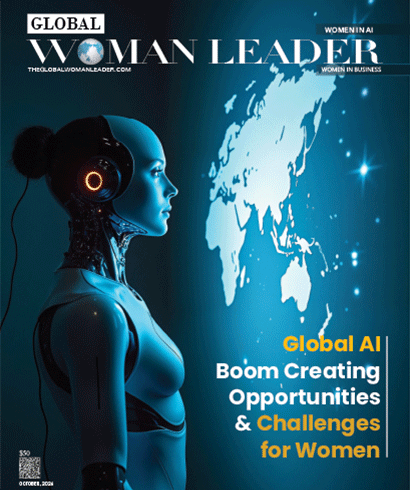
According to a report by Cheung Kong Graduate School of Business, as generative AI spreads across offices and factories, the technology is being adopted more by professional women than by their male counterparts and with less anxiety.
Authored by Associate Professor of Organisational Behavior at CKGSB, Zhang Xiaomeng, the report is based on a survey of nearly 11,814 respondents from a variety of industries.
The report showed that women-especially those with a higher education and rich work experience-us AI tools more frequently than men.
It also points to differences in emotional responses. Though concerns about automation are general, 73.5 percent of the male respondents reported anxiety about AI's impact on work against 70.8 percent of women. The biggest level of concern was shown by older male executives.
Zhang noticed that frequent use of AI tools seems to reduce anxiety, a pattern she described as "resilience squared," combining emotional and cognitive resilience.
In multinational firms, it is apparent that more emphasis is placed on human skills such as flexibility, empathy, and communication.
According to Poh-Yian Koh, FedEx China president, such skills are crucial for success in business. She gave an example of an online training activity where employees used their acquired low-code skill to build an application under short deadlines.
Domestic efforts have also encouraged women to be involved in technology. Currently, women make up approximately 45.8 percent of the scientific and technological workforce in China.
Initiatives such as Women’s Action for Scientific and Technological Innovation are aimed at tapping into female talent and assisting in the technological transformation of China.
Studies by UN Women and others have indicated that greater equality in the area of leadership might relate to economic expansion, better risk management, and overall performance of the company.
The role of women in determining the products of the company further indicates their contribution to innovation.
Despite the achievements, there are many issues that still exist today. According to experts, it has been found that biases may be replicated through the implementation of AI when past experiences are fed to AI systems, and that simply educating is not the solution to attain equal outcomes.
The data regarding AI adoption indicates there is potential for recalibrating in the labor force because greater representation of women is accompanied by greater flexibility and reduced anxieties regarding digital transformation. As Poh wrote, “Technology determines how fast we move. Humanity determines how far we go.”
Latest Issues
Most Viewed
🍪 Do you like Cookies?
We use cookies to ensure you get the best experience on our website. Read more...
Copyright © All rights reserved. Global Woman Leader Contact Us About